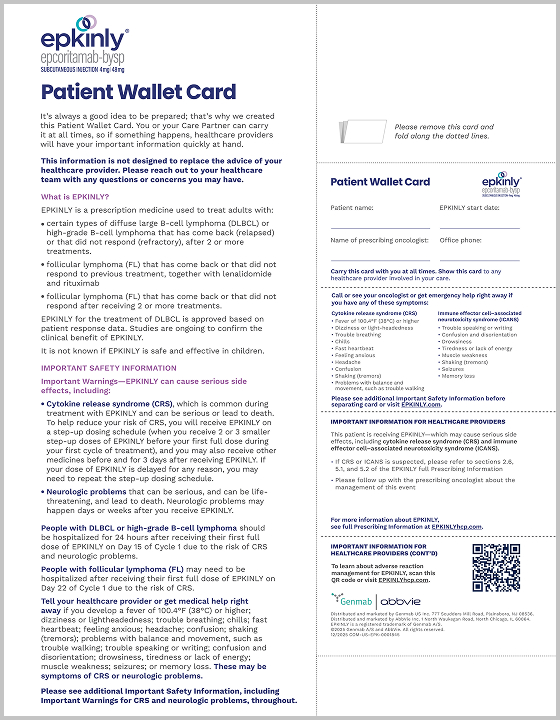
IMPORTANT SAFETY INFORMATION
Important Warnings—EPKINLY can cause serious side effects, including:
- Cytokine release syndrome (CRS), which is common during treatment with EPKINLY and can be serious or lead to death. To help reduce your risk of CRS, you will receive EPKINLY on a step-up dosing schedule (when you receive 2 or 3 smaller step-up doses of EPKINLY before your first full dose during your first cycle of treatment), and you may also receive other medicines before and for 3 days after receiving EPKINLY. If your dose of EPKINLY is delayed for any reason, you may need to repeat the step-up dosing schedule.
- Neurologic problems that can be serious, and can be life-threatening, and lead to death. Neurologic problems may happen days or weeks after you receive EPKINLY.
People with DLBCL or high-grade B-cell lymphoma may be hospitalized after receiving their first full dose of EPKINLY on Day 15 of Cycle 1 due to the risk of CRS and neurologic problems.
People with FL may be hospitalized after receiving their first full dose of EPKINLY on Day 22 of Cycle 1 due to the risk of CRS and neurologic problems.
Tell your healthcare provider or get medical help right away if you develop a fever of 100.4°F (38°C) or higher; dizziness or lightheadedness; trouble breathing; chills; fast heartbeat; feeling anxious; headache; confusion; shaking (tremors); problems with balance and movement, such as trouble walking; trouble speaking or writing; confusion and disorientation; drowsiness, tiredness or lack of energy; muscle weakness; seizures; or memory loss. These may be symptoms of CRS or neurologic problems. If you have any symptoms that impair consciousness, do not drive or use heavy machinery or do other dangerous activities until your symptoms go away.
EPKINLY can cause other serious side effects, including:
- Infections that may lead to death. Your healthcare provider will check you for signs and symptoms of infection before and during treatment and treat you as needed if you develop an infection. You should receive medicines from your healthcare provider before you start treatment to help prevent infection. Tell your healthcare provider right away if you develop any symptoms of infection during treatment, including fever of 100.4°F (38°C) or higher, cough, chest pain, tiredness, shortness of breath, painful rash, sore throat, pain during urination, feeling weak or generally unwell, or confusion.
- Low blood cell counts, which can be serious or severe. Your healthcare provider will check your blood cell counts during treatment. EPKINLY may cause low blood cell counts, including low white blood cells (neutropenia and lymphopenia), which can increase your risk for infection; low red blood cells (anemia), which can cause tiredness and shortness of breath; and low platelets (thrombocytopenia), which can cause bruising or bleeding problems.
Your healthcare provider will monitor you for symptoms of CRS, neurologic problems, infections, and low blood cell counts during treatment with EPKINLY. Your healthcare provider may temporarily stop or completely stop treatment with EPKINLY if you develop certain side effects.
Before you receive EPKINLY, tell your healthcare provider about all your medical conditions, including if you have an infection, are pregnant or plan to become pregnant, or are breastfeeding or plan to breastfeed. If you receive EPKINLY while pregnant, it may harm your unborn baby. If you are a female who can become pregnant, your healthcare provider should do a pregnancy test before you start treatment with EPKINLY and you should use effective birth control (contraception) during treatment and for 4 months after your last dose of EPKINLY. Tell your healthcare provider if you become pregnant or think that you may be pregnant during treatment with EPKINLY. Do not breastfeed during treatment with EPKINLY and for 4 months after your last dose of EPKINLY.
The most common side effects of EPKINLY when used alone in DLBCL or high-grade B-cell lymphoma or FL include CRS, injection site reactions, tiredness, muscle and bone pain, fever, diarrhea, COVID-19, rash, and stomach-area (abdominal) pain. The most common severe abnormal laboratory test results with EPKINLY when used alone include decreased white blood cells, decreased red blood cells, and decreased platelets.
The most common side effects of EPKINLY when used together with lenalidomide and rituximab in FL include rash, upper respiratory tract infections, tiredness, injection site reactions, constipation, diarrhea, CRS, pneumonia, COVID-19, and fever. The most common severe abnormal laboratory test results with EPKINLY when used together with lenalidomide and rituximab include decreased white blood cells and decreased platelets.
These are not all of the possible side effects of EPKINLY. Call your doctor for medical advice about side effects.
You are encouraged to report side effects to the FDA at (800) FDA-1088 or www.fda.gov/medwatch or to Genmab US, Inc. at 1-855-4GENMAB (1‑855‑443‑6622).
Please see Medication Guide, including Important Warnings.
04/2026 COM-US-EPK-0002578










 Care Partner of Michael, a real EPKINLY patient