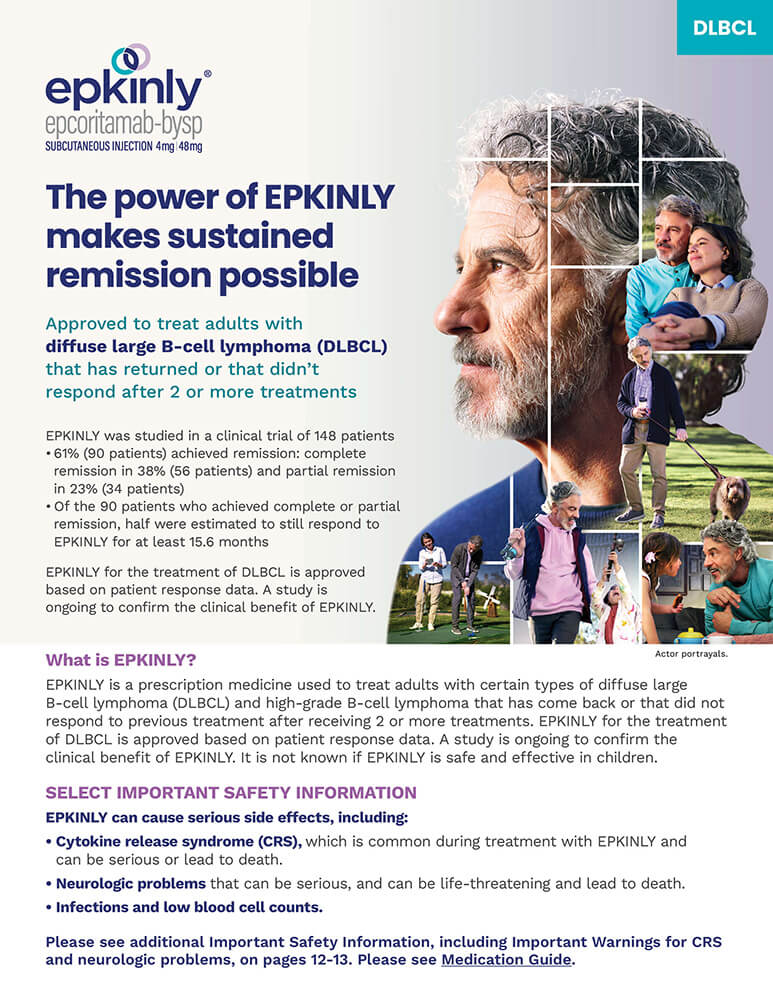
VO: EPKINLY is a prescription medicine used to treat adults with certain types of diffuse large B-cell lymphoma (DLBCL) and high-grade B-cell lymphoma that has come back (relapsed) or that did not respond (refractory) after 2 or more treatments. EPKINLY is approved based on patient response data. A study is ongoing to confirm the clinical benefit of EPKINLY. It is not known if EPKINLY is safe and effective in children.
Please see additional Important Safety Information, including Important Warnings for CRS and neurologic problems, throughout this video.
Kimberly: When I was thrust into the role of care partner, it's not something that you ease into, it's something that one day you’re a spouse and the next day you're a care partner, responsible for a lot of medical decisions and learning medical things that you never had a desire to even know about…
I did not realize how much advocation that you need to do for your patient.
What I would tell myself is I learned probably several months in, but learned the hard way a couple times, that you’re with your patient 24/7. The medical professionals are great. They're committed to the patients, but they only see them in snapshots, so that if something doesn't feel right it's okay to push back. It's okay to ask questions.
…You tend not to want to question doctors…But what I learned is that when you have a care team, I mean, some days you would see 6 or 7 specialists at a time when he was in the hospital because he was so sick, and they saw what was their specialty, but they didn't see the whole picture.
And I soon learned that they actually appreciate when you ask questions or mention things that maybe another doctor saw. I also learned to go with your gut instinct because you know your patient, you're with them 24/7, whereas the doctors only see them at certain times. And so asking those hard questions and kind of being the squeaky wheel is okay.
And if it turns out that what you're bringing up is irrelevant, fine, that's great. But that one thing that you bring up could be the difference in their health care or the difference in a decision…Being that advocate for the person that you're going through this with is really important.
Whenever I would get overwhelmed, I had three very close friends that I had chosen right from the beginning that they would be my sounding board. So if I was upset because Michael wasn't drinking his 3000 calorie shake that I had just spent 15 minutes making because I'm trying to help him gain weight, I wouldn't complain to him. I would complain to my friends…
One thing that I've learned about DLBCL, and that I'd like to share with other care partners, is that it doesn't mean that things are hopeless. We've all heard stories that make us feel hopeless in the past, but we want our story to be one to say that there is hope.
And sometimes hope is just for tomorrow…But there is hope.
VO: EPKINLY is a prescription medicine used to treat adults with certain types of diffuse large B-cell lymphoma (DLBCL) and high-grade B-cell lymphoma that has come back (relapsed) or that did not respond (refractory) after 2 or more treatments. EPKINLY is approved based on patient response data. A study is ongoing to confirm the clinical benefit of EPKINLY. It is not known if EPKINLY is safe and effective in children.
EPKINLY can cause serious side effects, including:
- Cytokine release syndrome (CRS), which is common during treatment with EPKINLY and can be serious or lead to death. To help reduce your risk of CRS, you will receive EPKINLY on a step-up dosing schedule (when you receive 2 smaller step-up doses of EPKINLY before your first full dose during your first cycle of treatment), and you may also receive other medicines before and for 3 days after receiving EPKINLY. If your dose of EPKINLY is delayed for any reason, you may need to repeat the step-up dosing schedule.
- Neurologic problems that can be serious, and can be life-threatening and lead to death. Neurologic problems may happen days or weeks after you receive EPKINLY.
People with DLBCL or high-grade B-cell lymphoma may be hospitalized after receiving their first full dose of EPKINLY on Day 15 of Cycle 1 due to the risk of CRS and neurologic problems.
Tell your healthcare provider or get medical help right away if you develop a fever of 100.4°F (38°C) or higher; dizziness or lightheadedness; trouble breathing; chills; fast heartbeat; feeling anxious; headache; confusion; shaking (tremors); problems with balance and movement, such as trouble walking; trouble speaking or writing; confusion and disorientation; drowsiness, tiredness or lack of energy; muscle weakness; seizures; or memory loss. These may be symptoms of CRS or neurologic problems. If you have any symptoms that impair consciousness, do not drive or use heavy machinery or do other dangerous activities until your symptoms go away.
EPKINLY can cause other serious side effects, including:
- Infections that may lead to death. Your healthcare provider will check you for signs and symptoms of infection before and during treatment and treat you as needed if you develop an infection. You should receive medicines from your healthcare provider before you start treatment to help prevent infection. Tell your healthcare provider right away if you develop any symptoms of infection during treatment, including fever of 100.4°F (38°C) or higher, cough, chest pain, tiredness, shortness of breath, painful rash, sore throat, pain during urination, or feeling weak or generally unwell, or confusion.
- Low blood cell counts, which can be serious or severe. Your healthcare provider will check your blood cell counts during treatment. EPKINLY may cause low blood cell counts, including low white blood cells (neutropenia), which can increase your risk for infection; low red blood cells (anemia), which can cause tiredness and shortness of breath; and low platelets (thrombocytopenia), which can cause bruising or bleeding problems.
Your healthcare provider will monitor you for symptoms of CRS, neurologic problems, infections, and low blood cell counts during treatment with EPKINLY. Your healthcare provider may temporarily stop or completely stop treatment with EPKINLY if you develop certain side effects.
Before you receive EPKINLY, tell your healthcare provider about all your medical conditions, including if you have an infection, are pregnant or plan to become pregnant, or are breastfeeding or plan to breastfeed. If you receive EPKINLY while pregnant, it may harm your unborn baby.
If you are a female who can become pregnant, your healthcare provider should do a pregnancy test before you start treatment with EPKINLY and you should use effective birth control (contraception) during treatment and for 4 months after your last dose of EPKINLY. Tell your healthcare provider if you become pregnant or think that you may be pregnant during treatment with EPKINLY. Do not breastfeed during treatment with EPKINLY and for 4 months after your last dose of EPKINLY.
The most common side effects of EPKINLY include CRS, tiredness, muscle and bone pain, injection site reactions, fever, stomach area (abdominal) pain, nausea, and diarrhea. The most common severe abnormal laboratory test results include decreased white blood cells, decreased red blood cells, and decreased platelets.
These are not all of the possible side effects of EPKINLY. Call your doctor for medical advice about side effects. You are encouraged to report side effects to the FDA at (800) FDA-1088 or www.fda.gov/medwatch or to Genmab US, Inc. at 1-855-4GENMAB (1-855-443-6622).
Please see Medication Guide, including Important Warnings, at EPKINLYMedGuide.com.